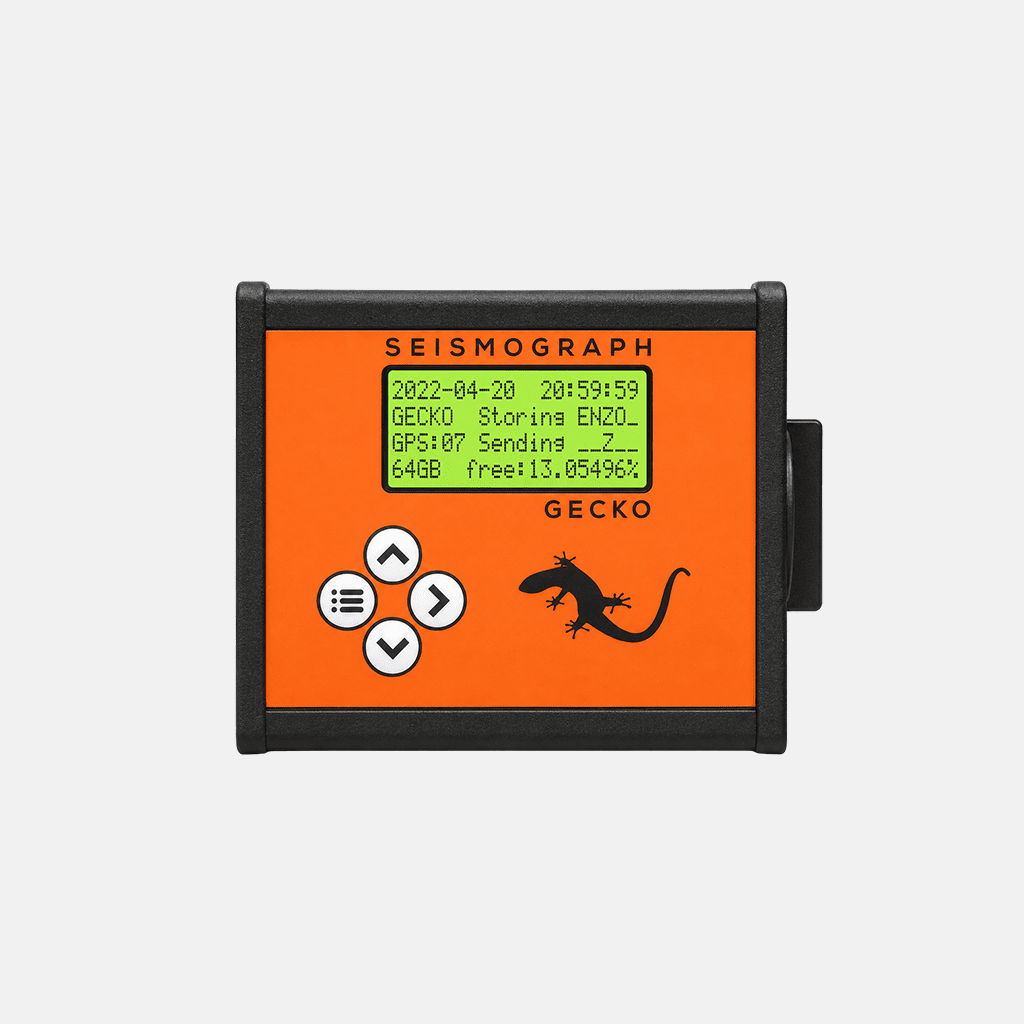
Gecko Compact Seismograph
Warranty
Installation
Training
Product overview
Field deployments don’t leave room for gear-heavy setups, and the Gecko Compact Seismograph solves that.
Out of the entire Gecko line, the Gecko Compact tends to be the one people point to as the best value option. It’s built around 3 channels for a triaxial sensor, plus a 4th channel that takes an auxiliary input, handy for something like a microphone when you need air pressure monitoring during blasting operations. There’s an in-built LCD and keypad too, so full instrument configuration can be done right there in the field, no laptop needed, which sounds minor until you’re standing at a remote site trying to get a unit running. As a trusted Gecko Compact Seismograph supplier serving the UAE, Saudi Arabia, Qatar, Kuwait, Oman, and Bahrain, BDHME helps field teams find the right configuration for their specific monitoring needs.
If remote access matters for a given deployment, you can connect an optional Ethernet, WiFi, or cellular modem and stream data straight to a server elsewhere.
Several models across the Gecko digital seismograph range come with internal triaxial acceleration or velocity sensors already housed in a waterproof body, which covers a lot of ground for most field applications without extra parts to manage. When a project calls for more flexibility, though, those same sensors are also available in external casings with cables that run to either the Gecko Compact or the Gecko Rugged.
We’ve also put together a newer configuration recently, the Gecko ERI (Earthquake Recording Instrument). It comes with a 12+ hour internal battery and charger, an Ethernet interface (no battery backup on that part), and 10A relay alarm contacts, all packed into one wall-mountable case. You can connect one of our triaxial velocity or acceleration sensors straight to it, though it’s worth flagging that some mass control features found in certain third-party sensors might not carry over fully to this particular configuration.
This generation of the Gecko seismograph is our 7th, and it’s built with field operation in mind first. The integrated user interface reflects that, it’s a real departure from earlier setups where getting the instrument configured often meant hauling extra equipment along just for that one task.
Modern seismology doesn’t really leave room for gaps in recording. You need continuous data, full stop, and that’s how the Gecko digital seismograph operates by design, always on, writing continuously to a removable SD card. Underneath that continuous capture is a 32-bit Analogue to Digital Converter (ADC), which stretches the range of amplitudes the instrument can pick up. Put in concrete terms, the ratio between the largest signal it can record and the smallest comes out to close to 8 million to 1, a range that ends up mattering quite a bit when you’re trying to catch both faint background tremor and a major seismic event on the same run.
With 4 channels available, the unit works well in setups that pair a triaxial geophone with a microphone, a fairly standard combination for vibration and blast compliance monitoring. Data gets captured continuously at rates between 50 and 4000 samples per second, which spans a genuinely wide frequency range, everything from long-period seismometers through to geophones, microphones, and accelerometers with a flat frequency response reaching up to 1.6kHz.
Where remote monitoring is needed, data can also be sent to an offsite computer via cellular modem or Ethernet adaptor. Power draw stays under 1W when working with passive sensors, low enough that a single car battery can keep it recording for more than a month on its own, or indefinitely if you add a small solar panel and a modest battery backup.
Choosing the Right Gecko Configuration
For teams weighing options across environmental monitoring, blast compliance work, or structural seismic projects, the Gecko Compact Seismograph tends to suit sites where reliable, self-contained field configuration matters more than carrying extra gear around. For work that calls for broader frequency coverage, research applications or regional monitoring networks in particular, the Gecko Prism broadband seismograph is worth a look as a complementary option within the same family, built to capture a wider range of seismic frequencies than the Compact is designed for.
BDHME supplies the full Gecko lineup to support engineering teams, environmental monitoring programs, and seismic networks that need dependable, field-ready recording equipment built to run continuously over the long haul.

Find the Right Solution for Your Laboratory
Need help selecting the right product for your application? Our specialists can guide you with product specifications, pricing, installation, and technical support across the UAE and Middle East.