
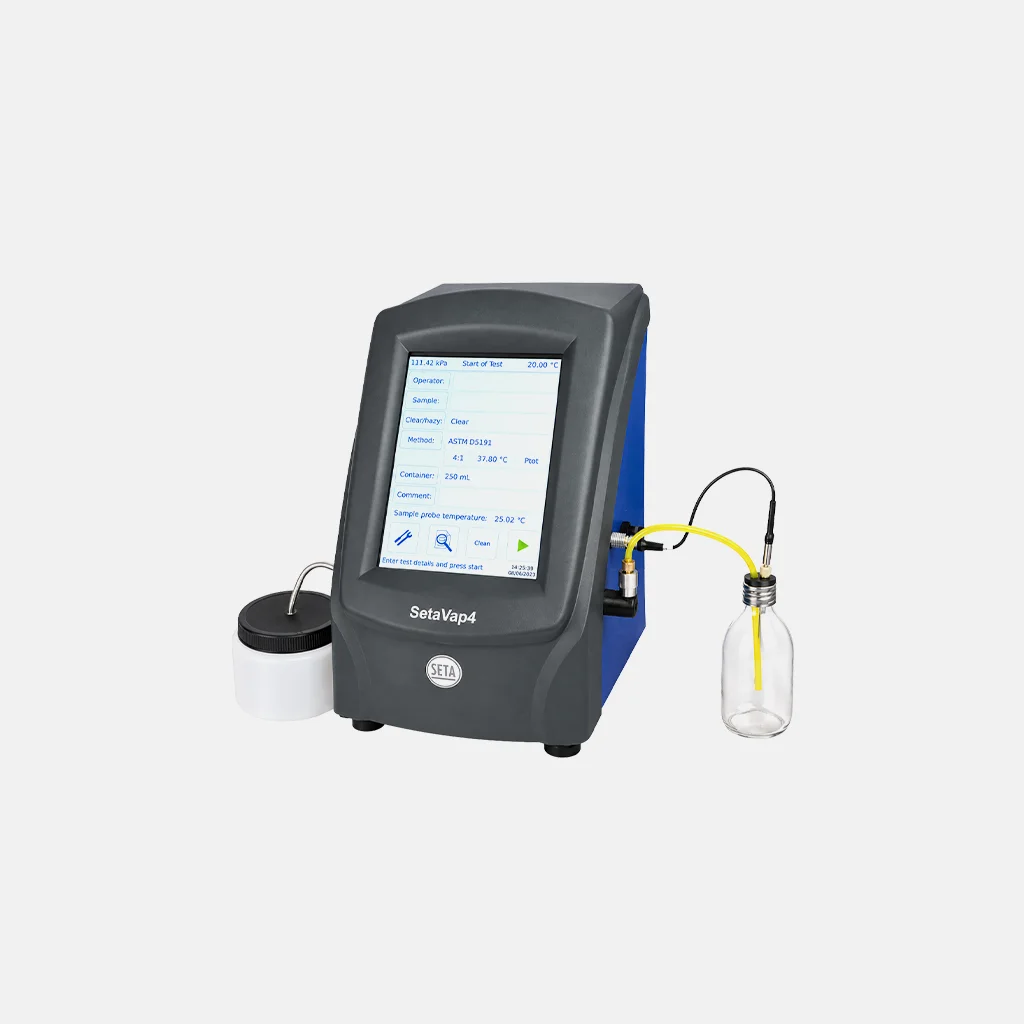
Vapour Pressure Analyzer
Warranty
Installation
Training
Product overview
The vapor pressure analyzer automates testing for gasoline, solvents, and light crude oil.
Labs that run high volumes of samples need vapor pressure testers that don’t slow down or drift out of accuracy. This system handles that pressure well. It’s a fully automated instrument designed for volatile liquids across petrochemical and refining applications, built to hold up under daily use in busy testing environments.
The piston based mechanism follows both single and triple expansion methods, generating DVPE, RVP, EPA, and CARB calculations without manual intervention. A minimum dead volume chamber keeps sample carryover low, so results stay clean run after run. Because the entire test sequence runs on its own, there’s little room for operator inconsistency to creep into your data.
This vapor pressure analyzer is built around a wide range of recognized testing standards, giving labs flexibility across different product types and regional requirements.
| Standard | What It Covers |
| ASTM D5191 | The mini method for testing vapor pressure in petroleum products, widely used across fuel testing labs for its speed and reliability. |
| IP 394 | Determines air saturated vapour pressure, known as ASVP, for liquid petroleum products under Part 1 of this standard. |
| ASTM D5188 | Uses an evacuated chamber approach to determine the vapor to liquid ratio temperature relationship in fuels. |
| ASTM D6378 | Applies the triple expansion method to measure vapor pressure across petroleum products, hydrocarbons, and hydrocarbon oxygenate mixtures. |
| ASTM D6377 | Covers crude oil testing using an expansion method to determine VPCRx values. |
| ASTM D6897 | Uses an expansion based method to determine vapor pressure specifically for liquefied petroleum gases (LPG). |
| EN 13016-3 | Applies the triple expansion method to calculate dry vapour pressure equivalent, or DVPE. |
| EN 13016-1 | Focuses on air saturated vapour pressure (ASVP) and its corresponding DVPE calculation. |
| ASTM D8009 | Outlines standard practice for manual piston cylinder sampling, especially for volatile crude oils, condensates, and liquid petroleum products. |
Innovative Design
The piston mechanism at the core of this analyzer keeps testing consistent from one sample to the next. Its low dead volume layout minimizes leftover sample between runs, so cross contamination stays low and each reading reflects the actual sample being tested. The system’s build supports both single and triple expansion protocols without needing separate setups.
Calibration and Verification
There are calibration procedures that are incorporated in the process, which ensures that the laboratory is always on the same page as per the ASTM and EN requirements. Verification processes happen along with testing procedures hence the accuracy is verified in the course of normal operations.
| Temperature range | 0 to 120 °C (no external cooling required). Test the sample for multiple temperatures (ASTM D6377) |
| Pressure range | 0-1000 kPa |
| Pressure resolution | 0.001 kPa |
| Units of pressure | kPa, psi |
| Temperature accuracy | better than 0.05 °C |
| Vapour to liquid ratio | 0.02:1 to 20:1. Test the sample for multiple V/L ratios (ASTM D6377) |
| Sample volume | 1 ml, plus rinsing |
| Measurement time | 5 minutes for D5191 |
| Lubrication | Automatic |
| Voltage | 100/240 Vac, 50/60 Hz, Auto-sensing universal power supply |
This vapor pressure analyzer supports testing across several industries, including
- Petrochemical processing
- Research and development labs
- Refineries
- Independent testing laboratories
- Paint manufacturing
- Grease production
- Lubricant formulation


Find the Right Solution for Your Laboratory
Need help selecting the right product for your application? Our specialists can guide you with product specifications, pricing, installation, and technical support across the UAE and Middle East.