
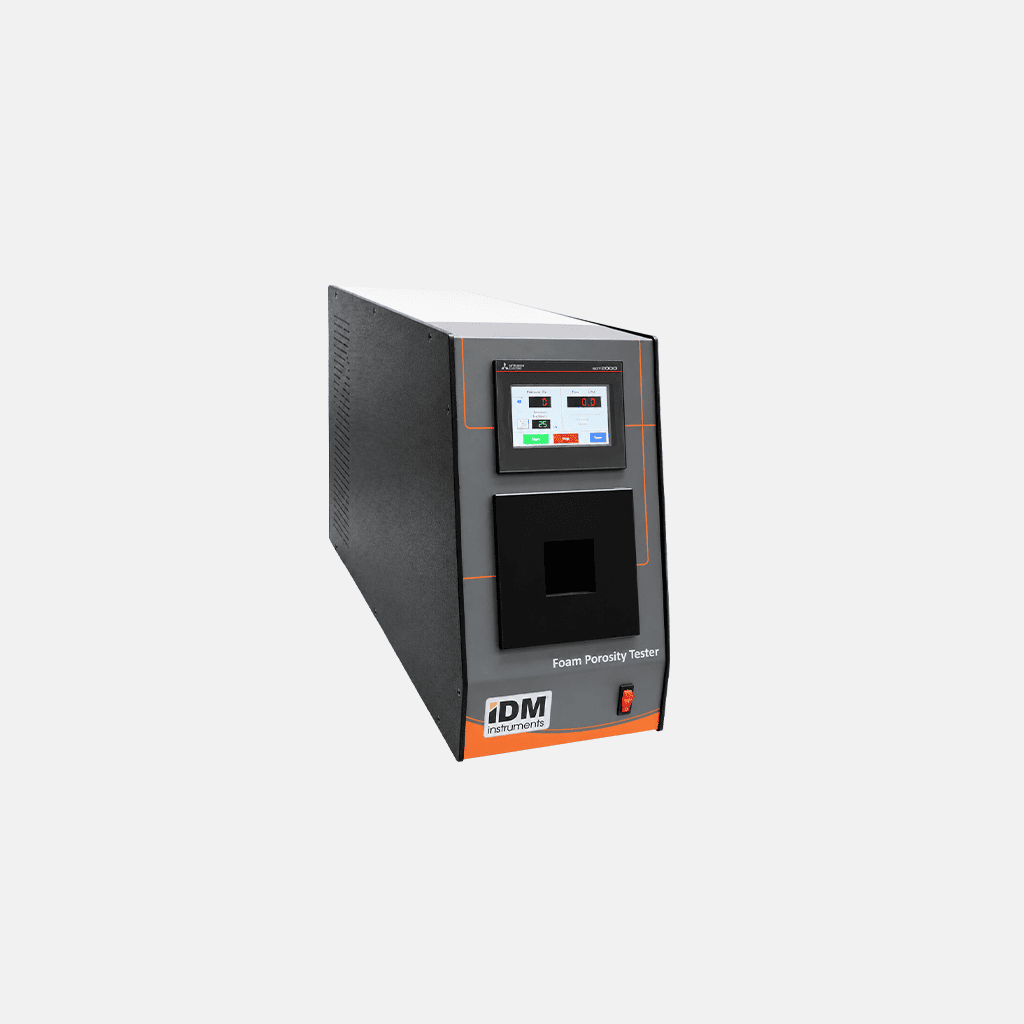
Foam Porosity Tester
Warranty
Installation
Training
Product overview
The Foam Porosity Tester measures how easily air passes through flexible cellular polyurethane, giving manufacturers an indirect read on cell structure quality.
There’s a lot about foam quality the porosity tells you, even if you can’t truly see it just by glancing at a sample. This instrument measures exactly that by measuring the freedom of air flow through a sample of flexible cellular polyurethane. Since airflow correlates closely with cell structure characteristics, the readings give manufacturers a genuinely useful, indirect window into material quality without needing to cut the foam apart or run destructive testing.
The unit is built around international standards for testing flexible cellular material at the standard 50mm x 50mm x 25mm specimen size, so results stay comparable across labs and facilities using the same method.
Running a test is straightforward. A specimen goes into the vacuum chamber cavity, and a specific constant air pressure differential gets created around it. The target pressure, measured in Pa, is set right on the digital display beforehand. Once the tester reaches that set pressure, the corresponding airflow rate locks in automatically, and the result appears on the flow display within seconds of the test finishing. There’s no manual calculation or guesswork involved at any point.
That kind of digital, automated operation makes a real difference when you’re running tests repeatedly throughout a shift. It cuts down testing time significantly and reduces the labour cost that comes with manual measurement methods, all while keeping results consistent from one test to the next.
For manufacturers, that consistency translates directly into better quality control. Checking incoming foam material for porosity before it enters production helps catch problems early, supporting quality assurance while keeping material waste and rework costs down.
As a trusted supplier of testing and measurement equipment across the UAE, Saudi Arabia, Qatar, Kuwait, Oman, and Bahrain, we supply foam porosity testers that manufacturers rely on to catch quality issues before they turn into costly problems downstream.
Foam Porosity Test Principle
A flexible cellular test piece sits in a cavity positioned above a vacuum chamber. A specified, constant air pressure differential is then created around the sample. The airflow rate required to hold that pressure differential steady becomes the recorded airflow value, which is what the tester ultimately reports.
Key Components
- Air flow meter
- Pressure meter
- Vacuum motor
- Touch screen control system
Test Screen
The test screen carries the setup, start and stop touch controls needed to run a test. It also displays the pre-set Pa pressure alongside the flow reading in litres per minute, so operators can monitor progress in real time.
Result Screen
Once the reading holds steady for 2 seconds, the tester automatically switches to the result screen and displays the final test outcome, no manual triggering required.
- AS 2282.14 – Methods for testing flexible cellular polyurethane, Method 14: Determination of air flow
- ISO 7231 – Polymeric materials, cellular, flexible – Determination of air flow value at constant pressure-drop
- EN ISO 7231
- BS EN ISO 7231
- DIN EN ISO 7231
- ASTM D3574 – Test G – Flexible Cellular Materials – Test G – Air Flow Test
- JIS K 6400 – Flexible cellular polymeric materials – Physical properties – Part 2: Determination of hardness (indentation technique) and stress-strain characteristics in compression.
- High, Medium, Low Density flexible cellular polyurethane
- Foam
- Mattress & Bedding
Find the Right Solution for Your Laboratory
Need help selecting the right product for your application? Our specialists can guide you with product specifications, pricing, installation, and technical support across the UAE and Middle East.