ICP-OES
Warranty
Installation
Training
Product overview
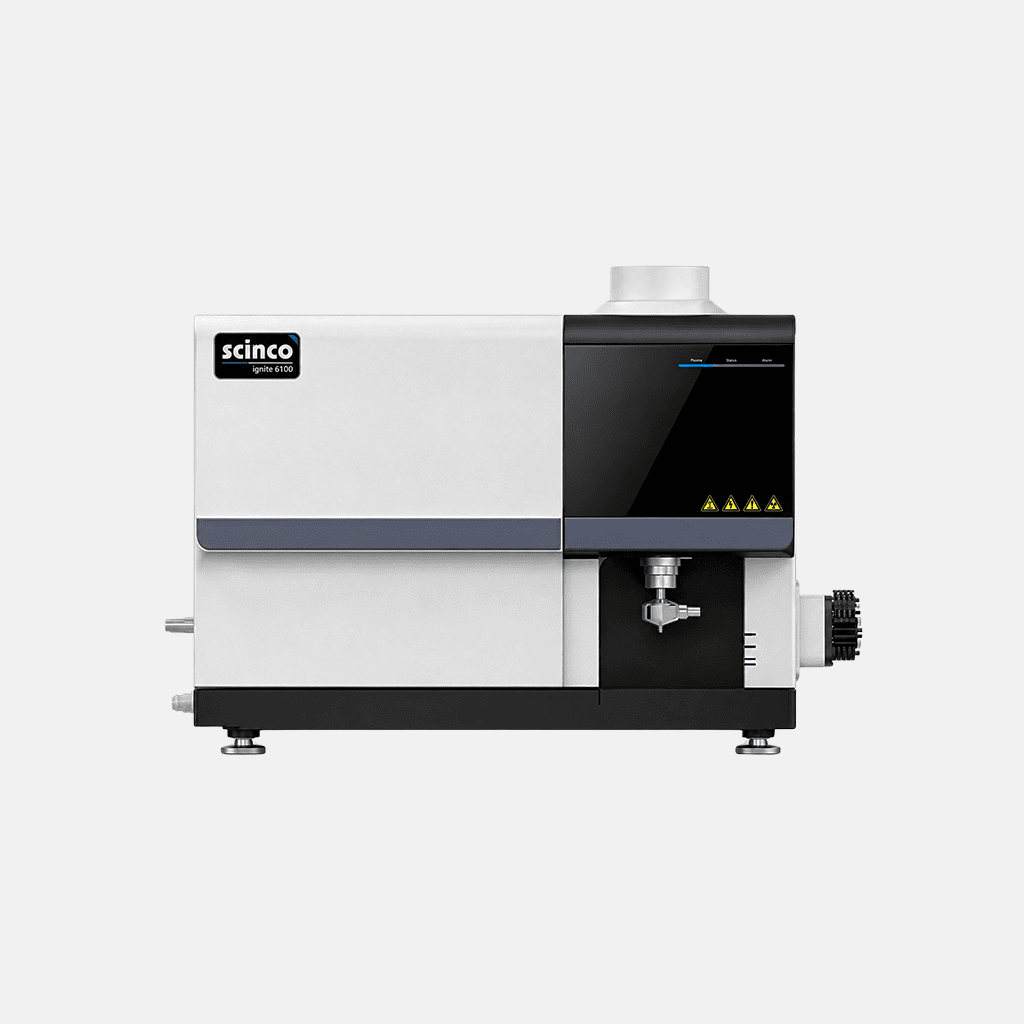
The Ignix 6100 is an ICP-OES instrument built around a stable RF power supply, a large 1-inch CCD detector, and thermally stabilized optics.
ICP-OES
Ignix 6100 Redefining the Standard of ICP-OES
ICP- OES (Inductively Coupled Plasma-Optical Emission Spectrometry) works by exciting the atoms of a sample by means of plasma and analyzing the light emitted by the atoms to identify the elements and quantify them in the sample. The Ignix 6100 is a next generation instrument based on this design. There are three real hardware things that count for the buyer in everyday use: The RF power supply, the larger detector, and a new way of observing the plasma while operating.
Performance:
RF power that drifts, even slightly, shows up as noise in your results. The Ignix 6100’s generator was tuned specifically to hold power steady across its full range, so plasma stability isn’t something you have to fight for.
Accuracy:
The CCD sensor is a full inch wide, bigger than what most instruments in this class use. More surface area picks up finer spectral detail, and that’s really where accuracy comes from when you’re trying to nail down trace element concentrations, not just detect that something’s there.
Robustness:
Heat is the enemy of any optical system. It causes drift, and drift is one of those problems you don’t notice until your calibration is suddenly off. The optics on the Ignix 6100 are thermally stabilized, so they stay put through long runs instead of needing to be checked and rechecked.
Versatility:
It’ll work with autosamplers and various accessories, which matters more than it sounds like. Nobody wants to reorganize their entire lab setup around a new instrument. This one’s meant to fit into what you’re already running.
Detector A custom 1-inch CCD sensor, larger than what you’d typically see here.
Optical System Solid-state, thermally stabilized, laid out in a multi-dimensional structure that keeps the light path from shifting between runs.
Torch Structure Made to handle high-salt matrices, which wear down a lot of torches fast. This one’s built to last without giving up sensitivity along the way.
RF Generator Holds steady from 500 up to 1600 W, a wider range than a lot of comparable systems offer.
Multi-Channel MFC System Nebulizer, cooling, and auxiliary gas flows are each controlled independently, so you can dial in exactly what you need without one setting messing with another.
Chemical:
- Checking purity in raw materials and reagents, QC work on salts, acids, and bases, corrosion and dissolution studies, and testing battery chemical materials.
Industrial:
- Shows up in mining and mineral processing, cement and glass manufacturing, ceramics, pharmaceutical production, and high-purity electronics work.
Environmental:
- Used for water testing, soil and sediment analysis, monitoring acid mine drainage and leachate, and tracking whether remediation efforts are actually working.
Food and Beverage:
- Testing nutritional mineral content, catching inconsistencies in beverage production, screening seafood and seaweed for safety, and checking for packaging migration.
Academia:
- Common in materials science, geochemistry, battery and energy materials research, and nanomaterials work.
Life Science:
- Used to analyze trace elements in biological samples, monitor metals in bioprocessing streams, and study how elements are distributed across tissue and organs.
Related Products
View all in Testing & Measurement
Find the Right Solution for Your Laboratory
Need help selecting the right product for your application? Our specialists can guide you with product specifications, pricing, installation, and technical support across the UAE and Middle East.