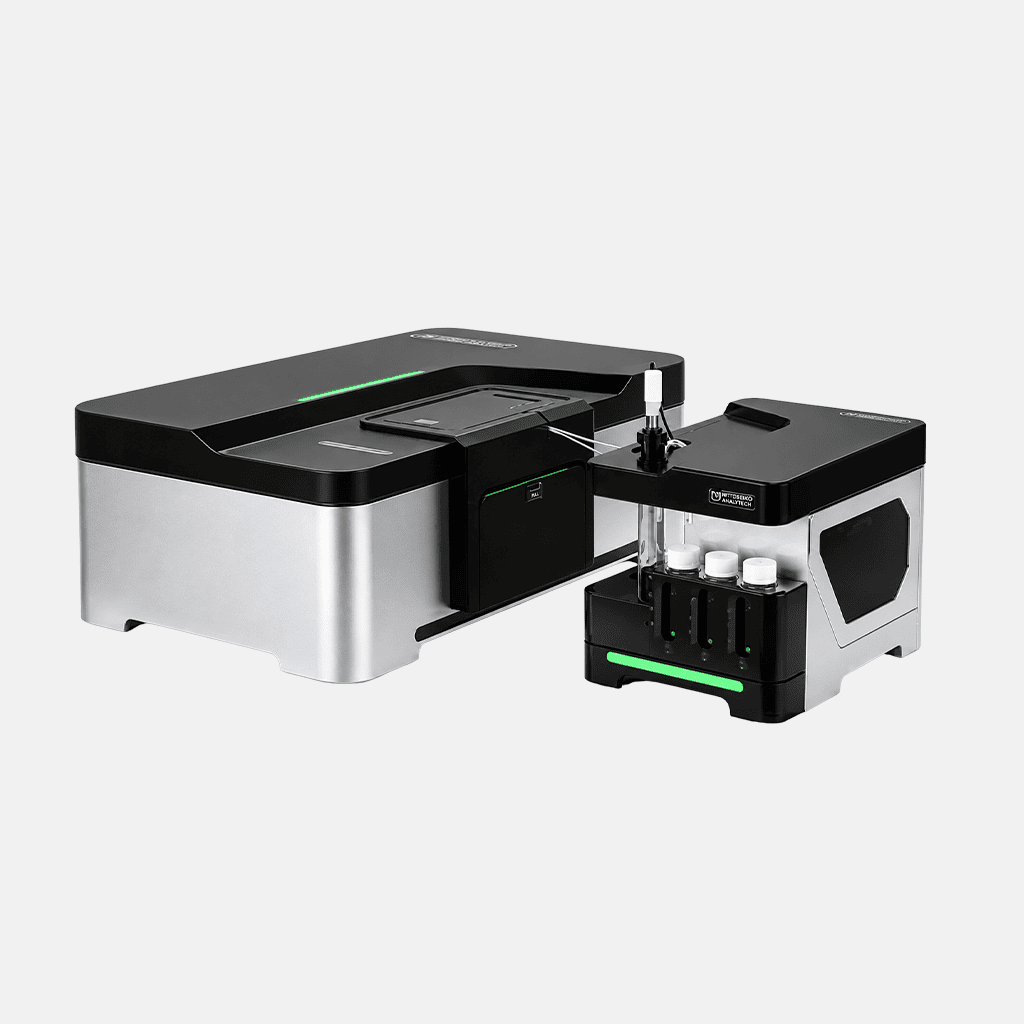
Zeta Potential Analyzer
Warranty
Installation
Training
Product overview
The Bettersize Zeta Potential Analyzer is a versatile zeta potential instrument combining ELS, DLS, and PALS in one system.
Two things really determine how a colloidal particle will behave in solution: how much charge sits on its surface, and how big it actually is. As a trusted zeta potential instrument supplier serving the UAE, Saudi Arabia, Qatar, Kuwait, Oman, and Bahrain, we built this system to answer both questions in one measurement session. The surface charge, known in the field as zeta potential, and the particle size distribution are both captured through a trio of light scattering methods working in tandem, Electrophoretic Light Scattering (ELS), Dynamic Light Scattering (DLS), and Phase Analysis Light Scattering (PALS).
Pulling from three techniques instead of relying on just one gives this particle size and zeta potential analyzer a wider reach than a single-method instrument typically offers. On top of particle size and concentration, it also outputs zeta potential, molecular weight, refractive index, and rheological data, so a research team gets a much more complete read on how a sample is likely to behave, without shuffling it between different pieces of equipment to get there.
Compliance with 21 CFR Part 11, ISO 22412, ISO 13099
Size range: 0.3nm to 15μm
This span reaches from small molecules and nanoparticles all the way up to larger colloidal particles. It’s broad enough to handle most of what turns up on the bench in pharmaceutical, chemical, and materials science labs relying on nanoparticle size analyzers for routine work.
Minimum sample volume: 3μL
Sample is often the limiting factor, especially with an expensive formulation or an early-stage research batch where there just isn’t much to spare. A 3μL requirement means labs aren’t forced to trade sample conservation for a dependable result.
APD (Avalanche Photodiode) detector
Sensitivity in this system comes down largely to the APD detector, which is built to register faint scattering signals with a good degree of accuracy. That becomes especially relevant with dilute samples, or with particles near the lower boundary of the size range, where weak signals are easily lost on less capable detectors.
Automatic laser intensity adjustment
Rather than manually recalibrating the laser for every new sample, the instrument adjusts intensity on its own. That keeps readings consistent as sample concentration shifts from one run to the next, without adding steps to the process.
Intelligent result evaluation algorithm
Software built into the system interprets scattering data as it’s collected and flags anything that looks like it needs a second look. This takes some of the manual interpretation burden off the operator and helps keep results consistent across different users.
DLS backscattering detection (173°)
Measuring backscatter at 173 degrees cuts down on interference from multiple scattering and sample contamination, both of which tend to show up more in concentrated or otherwise complex samples. It’s a fairly technical detail, but it has a real effect on how dependable zeta potential measurement is once you’re working outside of clean, ideal conditions.
User-adjustable scattering volume
Concentrated samples can be read directly, without dilution, because the scattering volume adjusts to suit. That sidesteps the accuracy problems that diluting a sample can sometimes introduce.
PALS technology
Phase Analysis Light Scattering brings an added degree of precision to zeta potential analysis, particularly with samples where ELS on its own doesn’t offer quite enough sensitivity to get a reliable read.
Programmable temperature control
Particle movement is closely tied to temperature, so being able to program and control it helps keep measurement conditions stable, whether comparisons are being made within the same day or across separate testing sessions weeks apart.
Find the Right Solution for Your Laboratory
Need help selecting the right product for your application? Our specialists can guide you with product specifications, pricing, installation, and technical support across the UAE and Middle East.