-
TURNKEY SOLUTIONS
Why BDH Middle East for
Turnkey Laboratory Solutions
From concept to commissioning — we design, build and equip complete testing laboratories for the Oil & Gas, Petrochemical, Food, Academic, Environmental and Commercial sectors across the GCC.
200+
Turnkey Labs Delivered
40+
Global Brand Partners
8
Industry Sectors
30+
Years of Engineering
OVERVIEW
Premier turnkey lab partner — engineered around you
We have successfully implemented numerous laboratory projects for well-known companies and EPC contractors (Engineering, Procurement, Construction) — across Oil & Gas, Petrochemicals, Smelters, Food, Academic, Sewage, Environmental and Commercial testing.
As a premier turnkey solution provider, we bring unmatched expertise to every project — planning and realizing your testing laboratory tailored to individual requirements, deadlines and standard testing methods.
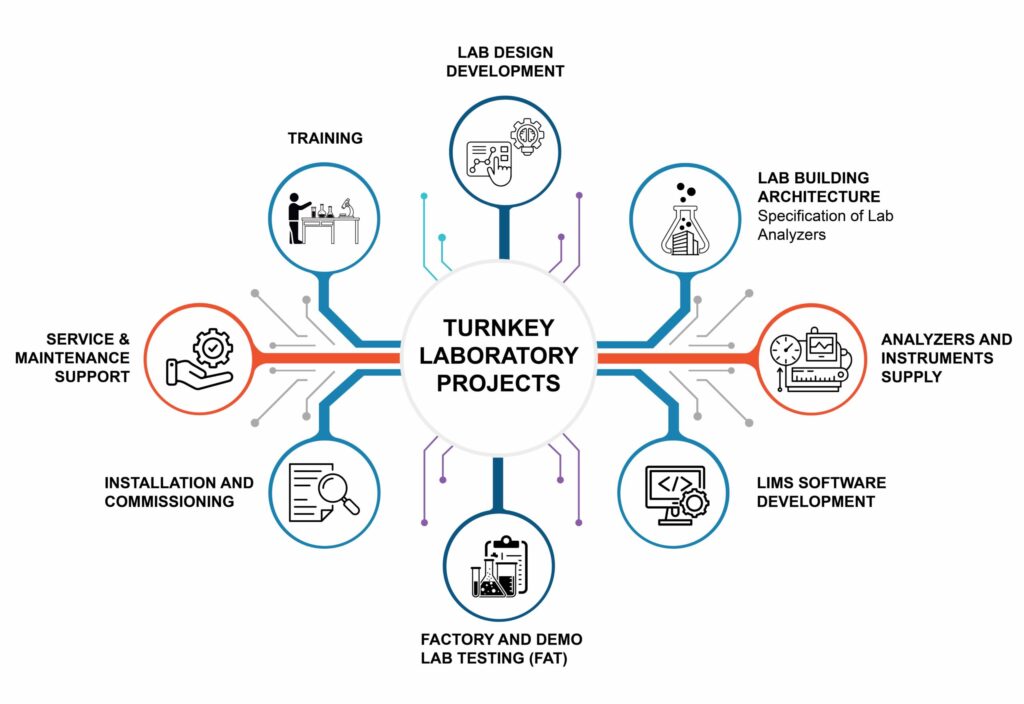
Turnkey Laboratory Solution
Laboratory Design
Safety & Containment: The primary goal is protecting workers and the environment. This includes strategic placement of fume hoods, emergency showers, and dedicated zones for hazardous materials to prevent cross-contamination.
The Lab Module: The "lab module" is the fundamental unit of design. It serves as a 3D grid that coordinates all architectural and engineering systems—such as utilities, casework, and structural columns—ensuring the space remains functional as it scales.
Flexibility & Future-Proofing: Because research needs evolve rapidly, architects use modular casework, mobile workstations, and overhead utility "quick-connects". This allows research teams to reconfigure over 25% of their space annually without major renovations.
Advanced Ventilation: HVAC systems often account for over 50% of construction costs. Designers must ensure precise air change rates and directional airflow to keep toxic vapors out of breathing zones.
Zoned Layouts: Facilities are typically divided into "clean" zones (offices, breakrooms) and "dirty" zones (wet labs, chemical storage) with strictly controlled transition points.
Durable Materials: Work surfaces require high-performance materials like epoxy resin or stainless steel to withstand chemical spills and heavy equipment.
Ergonomic Workspace Flow: Optimizing step-saving travel paths between sample preparation zones, analyzers, and waste disposal units to increase throughput and reduce physical operator strain.
ISO 10416:2008: Covers laboratory procedures for testing both water-based and oil-based drilling fluids, including necessary safety measures for chemical handling.
ISO 45001:2018: Occupational health and safety management systems mapping across high-exposure work environments.
OSHA Guidelines: OSHA regulates safe working conditions in laboratories, specifying standards for exposure limits, chemical hygiene plans, and personal protective equipment (PPE).
NFPA 45: Standard on Fire Protection for Laboratories Using Chemicals, governing maximum quantities of flammable liquids allowed per lab unit area.
Engineering Drawing and Documentation
Civil and Architecture: General Arrangements layout shall be prepared within the implementation limits of Architectural drawing and Lab building space allotments.
Mechanical and Piping: Gases and Exhaust systems shall be designed based on the Analyzers consumptions and Exhaust requirements such as AAS, ICP, Fumehoods.
Electrical: Design of Electrical Power distribution system based on the project specification and Analyzer power consumption.
Signal and Networking: LIMS networking layouts for Data processing, fiber paths, servers, and telecommunications routing.
Fire Alarm and Fire Fighting System: Safety norms shall be followed based on the laboratory zonal specification, utilizing clean-agent suppression where sensitive instruments reside.
3D BIM Modeling & Clash Detection: Building Information Modeling integration to preemptively resolve structural, utility, and ducting overlap conflicts before ground installation.
ISO 9001:2015: For the documentation procedure to be followed based on the Project requirements – PQMS.
EDMS (Engineering Document Management Systems): Document tracking on the submission, revision, versions and following with QMS (Quality Management System).
ISO/IEC 27001 Data Security: Applied across digital architecture frameworks to guarantee security of engineering files, schematic versions, and sensitive design intellectual property.
BOM - Analyzer and Instruments Finalization
Inputs: Sampling Schedules, Test Method Requirements, and Product Analysis requirement (Finished Product requirements).
Method Analysis: Identifying the required testing methods (e.g., Chromatography, titration, pH, photometry) and selecting analyzers that meet these specifications.
Design Alignment: Ensuring selected instruments fit within Process requirement and test method requirements.
Instrument Data: Instrument data shall be relayed to the laboratory design, including space occupancy, furniture layouts, heat dissipation, and ventilation requirements.
Quantity Analysis: Calculating the total number of analysis as per the process requirements and analyze with equipments / Analyzer's testing run time and process sampling schedule.
Configuration & Accessories Checking: Using a Quantity and Analyzer testing time - support equipment such as Autosamplers, Sample preparation units, Ovens, Baths, Fumehood shall be finalized.
Validation: The Analyzer shall be validated with respect to the process requirements and Laboratory schedule to develop LIMS.
Laboratory Utilities
Purpose: The primary goal for lab HVAC is safety through containment and dilution of hazardous vapors.
Airflow Direction: Labs are typically kept at a negative pressure relative to adjacent corridors to prevent odors and contaminants from escaping.
Ventilation Rates: Design is often based on 6–12 Air Changes per Hour (ACH), though this depends on heat loads and chemical use.
100% Outside Air: Most high-hazard labs use 100% fresh outside air with no recirculation to avoid cross-contamination.
Exhaust Systems: Dedicated exhaust fans and stacks (often with high-velocity discharge) are used for Fume Hoods and canopy hoods.
Standards: ASHRAE Laboratory Design Guide and ANSI Z9.5 for compliance.
System Layout: Designing the distribution of circuits, panels, and lighting systems.
Load Calculations: Estimating the total power demand for the building.
Power Density: Labs require significantly higher power densities than offices to accommodate equipment like centrifuges, mass specs, and incubators.
Backup Power: Critical equipment (e.g., -80°C freezers, incubators) should be connected to an Uninterruptible Power Supply (UPS) or emergency generator.
Flexibility: Utilize overhead service carriers or modular "plug-and-play" busways to allow for easy reconfiguration of bench equipment.
Safety: Ground Fault Circuit Interrupters (GFCI) are mandatory near any water source, such as sinks or emergency showers.
Water Types: Systems may include potable water, Deionized (DI) water, or Reverse Osmosis (RO) water matching structural purity tiers.
Effluent Treatment: Lab waste often flows through an acid neutralization system or dilution tank to adjust pH before entering the municipal sewer.
Pipe Materials: Use corrosion-resistant materials like High-Density Polyethylene (HDPE) or uPVC, depending on the chemical waste profile.
Emergency Fixtures: Emergency eye washes and showers must have a dedicated water supply and, in some jurisdictions, floor drains to capture large spills.
Gas Distribution System
Gas Segregation: Incompatible gases (e.g., oxidizers like oxygen and flammables like hydrogen) must be stored and piped separately to prevent dangerous interactions.
Gas Source Management: Cylinders should be housed in a designated, ventilated area, ideally outside the laboratory space.
Manifolds & Regulators: Use automatic changeover manifolds to ensure continuous supply. High-quality pressure regulators must be used at the source to control delivery pressure.
Piping Materials: Pipes must be compatible with the gas type. For high-purity gases, electro-polished stainless steel (Grade 316L) is recommended.
BCGA Code of Practice 4 (UK): This is a primary standard for industrial gas cylinder manifolds and distribution pipework (up to 54 mm nominal bore, 50 bar pressure).
NFPA 55: The Compressed Gases and Cryogenic Fluids Code is widely recognized for regulating storage, use, and handling of compressed gases in portable and stationary cylinders.
ISO 14224:2016: Focuses on the collection and exchange of reliability and maintenance data for equipment in the petrochemical and natural gas industries.
Local Regulations: Many regions adopt the International Building Code (IBC) or specific national codes for gas systems.
Installation & Testing: The system must undergo rigorous pneumatic pressure testing and leak detection tests before being placed into service.
Labeling: All pipelines should be clearly labeled with the gas type, color code, and flow direction according to ASME A13.1.
Maintenance: Regular inspection of joints, valves, regulators, and sensors is mandatory to ensure ongoing safety and compliance.
Safety Features: Systems must include flash-back arrestors (for flammable gases), check valves, and pressure relief valves.
Leak Detection: Continuous, active monitoring and gas detectors are necessary for early detection of hazardous toxic or flammable concentration conditions.
Installation, Commissioning and Training
Prerequisite requirements will be verified by our team before the installation of Analyzers: Gas points, Power connections, Water connections, Drain connections, and Extraction Hoods.
Our Installation Team will unpack and verify all the delivery Equipment's based on the Delivery note.
Install / Commission all Equipment's to its designated area based on the General Arrangement Drawing.
All the utility connections such as Water, Drain, Gases, Power will be connected to all the Equipment's.
Pre-Commissioning: Involves equipment acceptance, physical installation, and "dry tests" to ensure components function before the system is fully energized.
Start-up & Handover: Includes final parameterization, personnel training, and the formal handover of documentation like User & Functional Design Specifications (URS & FDS).
Site Acceptance Testing (SAT): Final on-site verification that the system is working as per end-user requirements within its actual operating environment. Standard testing protocols ensure the analyzer provides accurate results across various applications.
Calibration & Validation: Critical for ensuring measurement results align with international standards such as ISO, ASTM, and UOP.
IQ/OQ/PQ Protocols: Deep execution of Installation Qualification, Operational Qualification, and Performance Qualification documentation sets to satisfy structural compliance.
Trained Engineers and OEM will provide Class Room and Hands-on training to Lab Chemist and Maintenance team for: Standard Operation (SOP), Minor Periodic maintenance, Calibration, Sample Preparation, and Results verification using standards.
Laboratory Information Management System (LIMS)
A standard LIMS manages the entire sample lifecycle—from registration and tracking to testing and disposal.
Sample Management: Assigns unique IDs (barcodes/RFID tokens) for real-time tracking across departments.
Workflow Automation: Standardizes protocols to ensure all staff follow the same steps, reducing human error.
Inventory & Equipment: Tracks reagent stocks, automates reordering, and schedules instrument calibration or maintenance.
Instrument Integration: Connects directly to lab hardware (e.g., HPLC, sequencers) to capture data automatically, eliminating manual entry errors.
Audit Trail Integrity: Maintains full time-stamped history tracks of all data creations, modifications, and user approvals to eliminate record tampering possibilities.
Certificates of Analysis (CoA): These are documents that verify a product meets its specifications.
Regulatory Reports: These are summaries for standards such as ISO 17025 or FDA 21 CFR Part 11.
Operational Dashboards: These offer real-time views of sample throughput, staff productivity, and instrument uptime matrices.
Development Methods: Ready-made Templates — many modern LIMS offer pre-built templates. Configurable Tools — some systems allow users to design custom reports and screens without complex coding. Advanced Analytics — integration with AI tools helps identify trends in data.
AMC and Calibration Capabilities
Installation, Demonstration & Training of Instruments.
Warranty & Service Support framework.
Annual Maintenance for Instruments featuring scheduled preventive care checklists.
We have a group of well-trained service engineers who have undergone specialized training at manufacturer facilities.
24/7 Emergency Breakdown Response: Rapid response deployment guarantees minimizing downtime for critical analytical processes.
Temperature: Sensor, Oven, Gauge, Controller, Thermometer.
Pressure: Switch, Transmitter, Gauge testing equipment.
Force: Universal Testing Machines, Hardness Testers, Compressor Testing Machines, Load Cells.
Mass: Weighing Balances, Weights & Scales.
Additional Parameters: Dimension, Electrical, Hardness, Volume calibration procedures.
OUR RESPONSIBILITY
Overall responsibility for your individual & turnkey lab
Identify and define space utilization based on space occupancy
Develop turnkey lab interiors — furniture layouts & circulation flow
Recommend equipment for proper ventilation & exhaust
Plan workspace, storage, equipment and consumable needs
COMPLETE SCOPE OF WORK
Everything covered — under one
contract
BOM finalization based on required testing methods, design inputs, project specification & sample schedules
Utility requirements for all selected analyzers — Electrical, Gases, Water, Exhaust Systems, Bench Space, Fumehoods, etc.
Design of laboratory layout based on applications and EHS (Environment, Health & Safety)
Deliver, install, commission and test Lab Furniture, Fume Hoods, GDS and Analyzers with required support instruments
Comprehensive training & long-term service support
LIMS — Laboratory Information Management System with Networking, HMI, Servers and Switches
CORE PILLARS
Six pillars of a fully turnkey laboratory
Lab Architecture
3D-modelled lab layouts engineered around your application, utility and HVAC envelope — optimized for workflow, safety and future expansion.
Analyzers & Instruments
Multi-vendor specification of analytical instruments, support equipment, glassware and consumables — sourced from our network of 40+ global brands.
LIMS Software
Laboratory Information Management Systems that handle high-volume data, ensure standards compliance, automate workflows and eliminate human error.
FAT — Factory Acceptance Test
Documented FAT validating exhaust, LIMS, GDS and equipment against PO specs — covering scope, drawings, ITP, codes, checklists and certifications.
Installation & Commissioning
Diverse, experienced engineering team performing installation, commissioning and SAT — including on-site calibration and prerequisite verification.
Training & Service Support
Operator and method training, preventive-maintenance contracts and lifetime service support to keep your lab running at peak performance.
INDUSTRIES SERVED
Turnkey labs across every demanding
sector

Oil & Gas / Refineries

Petrochemicals

Smelters & Steel

Sewage & Water

Academic & Research

Environmental Monitoring

Food & Beverage Labs
Planning a new lab or upgrading an existing one?
end-to-end.