
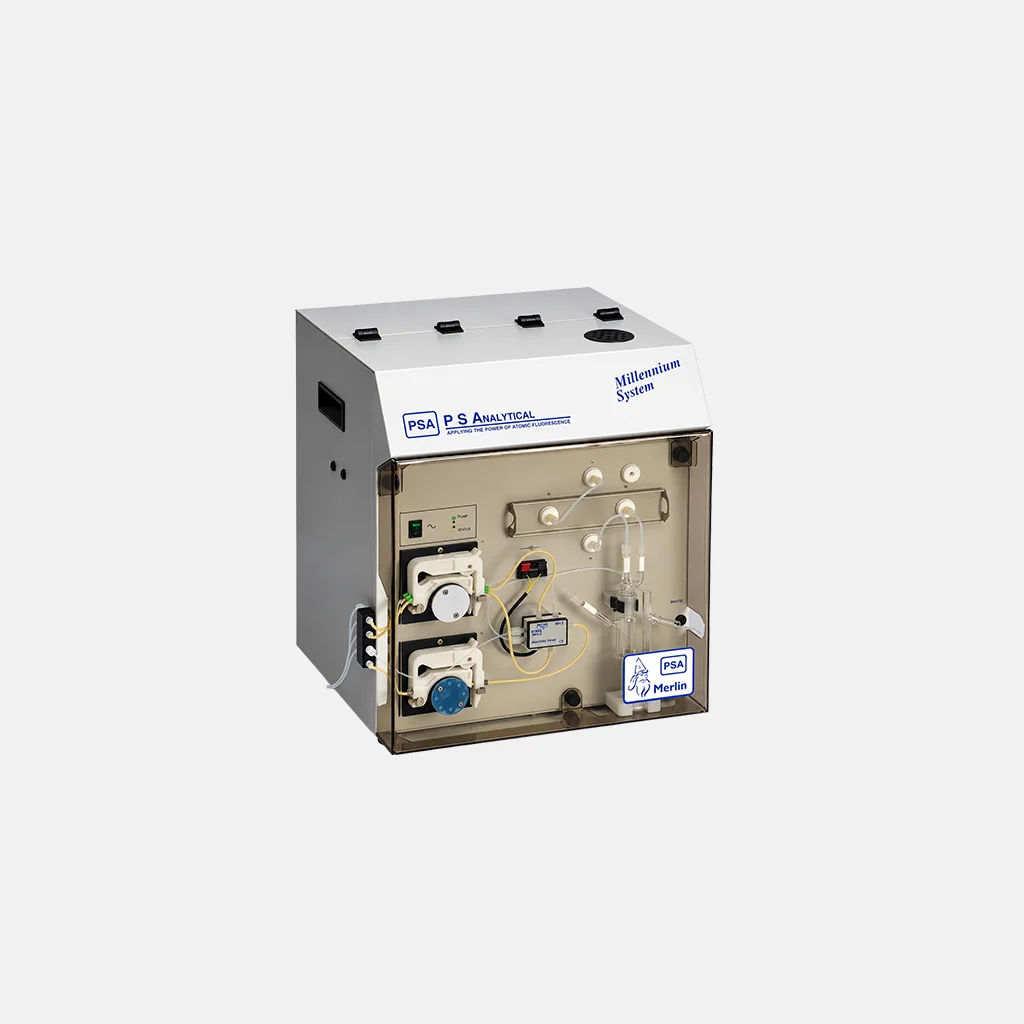
Atomic Fluorescence Spectrophotometer
Warranty
Installation
Training
Product overview
P S Analytical builds instrumentation for detecting mercury and related elements using atomic fluorescence spectrometry
P S Analytical has built its reputation around one specific problem: detecting trace amounts of Mercury, Arsenic, Selenium, Antimony, Bismuth and Tellurium, no matter what form the sample takes. Gases, liquids, solids, it doesn’t matter much to their equipment, and that versatility is a big part of why labs keep coming back to them.
Most of their instruments run on atomic fluorescence spectrometry rather than the older atomic absorption approach. There’s a reason for that switch. When you’re trying to pick up mercury or any of the hydride-forming elements at very low concentrations, fluorescence-based detection tends to outperform absorption methods on sensitivity, selectivity and linearity. That said, some regulatory frameworks still specifically call for atomic absorption, so PSA keeps those systems available too rather than forcing everyone onto one method.
What helps the company remain important is that they do not merely market boxes manufactured in bulk. Their R&D department always keeps track of regulations, as well as customers’ needs, so they can adjust quickly by altering a regular atomic fluorescence spectrophotometer for a new usage or creating a product for a customer with a typical specifications.That combination of standard reliability and willingness to customize is largely what’s earned them their standing in the analytical instrumentation space.
The PSA 10.525 Sir Galahad was built with one job in mind: measuring mercury in gas samples, whether that’s an online continuous setup or a one-off offline measurement. It handles sampling through a dual purge and trap system built around PSA’s own Amasil traps, and it can run in either continuous or remote mode depending on what the installation calls for.
On the compliance side, it meets both ISO 6978:2 and ASTM 6350-98, the two standards most commonly referenced for mercury measurement in natural gas. And the sensitivity is genuinely impressive. Because it relies on atomic fluorescence detection, it can pick up mercury at levels below 0.1 picogram, which is well beyond what most absorption-based systems can reach.
Running the instrument day to day happens through either the dedicated Sir Galahad software or PSA’s broader online software platform, both accessible from a standard PC or laptop. There’s also a fairly wide range of accessories available for it, enough that the same core unit can be adapted for jobs as different as testing mercury in exhaled breath and checking mercury levels directly in gasoline.
Methods: ISO 6978:2 and ASTM 6350-98
Natural gas analysis is probably the most common application, both at fixed installations and out in the field, but it’s far from the only one. The same analyser sits at the core of PSA’s online mercury CEMs used at power plants, crematoria and incinerator stacks, monitoring emissions in real time. It also turns up in ambient air studies, tracking mercury levels across urban and rural sites, and in industrial settings measuring mercury contamination in gases like hydrogen and carbon dioxide.
One practical detail worth mentioning: the unit is genuinely portable. It comes housed in a trolley-style carry case, so moving it between sites doesn’t require a full logistics operation, which matters a lot for anyone doing fieldwork rather than fixed lab testing.
PSA also builds a set of ambient air sampling modules designed to pair directly with the Sir Galahad, covering both passive and active sampling depending on the study. Their newer G525S100 Air Sentinel is worth a mention here. It’s an unattended, active sampling device built specifically to capture accurate air volume data for mercury studies, which removes a lot of the manual oversight that older sampling setups required.
Beyond that, there’s a fairly specific range of sampling modules for particular situations: explosion-proof units for natural gas work, dual amalgamation units that confirm all the mercury present has actually been captured, alternating dual amalgamation setups that allow continuous measurement and can catch transient emission peaks that a single-cycle system might miss, and specialized units built for natural gas streams where hydrogen sulphide levels run high enough to interfere with standard sampling.
For mercury analysis that needs to be built into a larger engineering project rather than run as a standalone measurement, PSA works directly alongside client engineering teams. Rather than forcing a fixed product into a project, they combine their analytical background with whatever the client’s engineers are already building, which tends to produce a more workable, fully customised setup than either side would land on alone.
Related Products
View all in Testing & Measurement
Find the Right Solution for Your Laboratory
Need help selecting the right product for your application? Our specialists can guide you with product specifications, pricing, installation, and technical support across the UAE and Middle East.