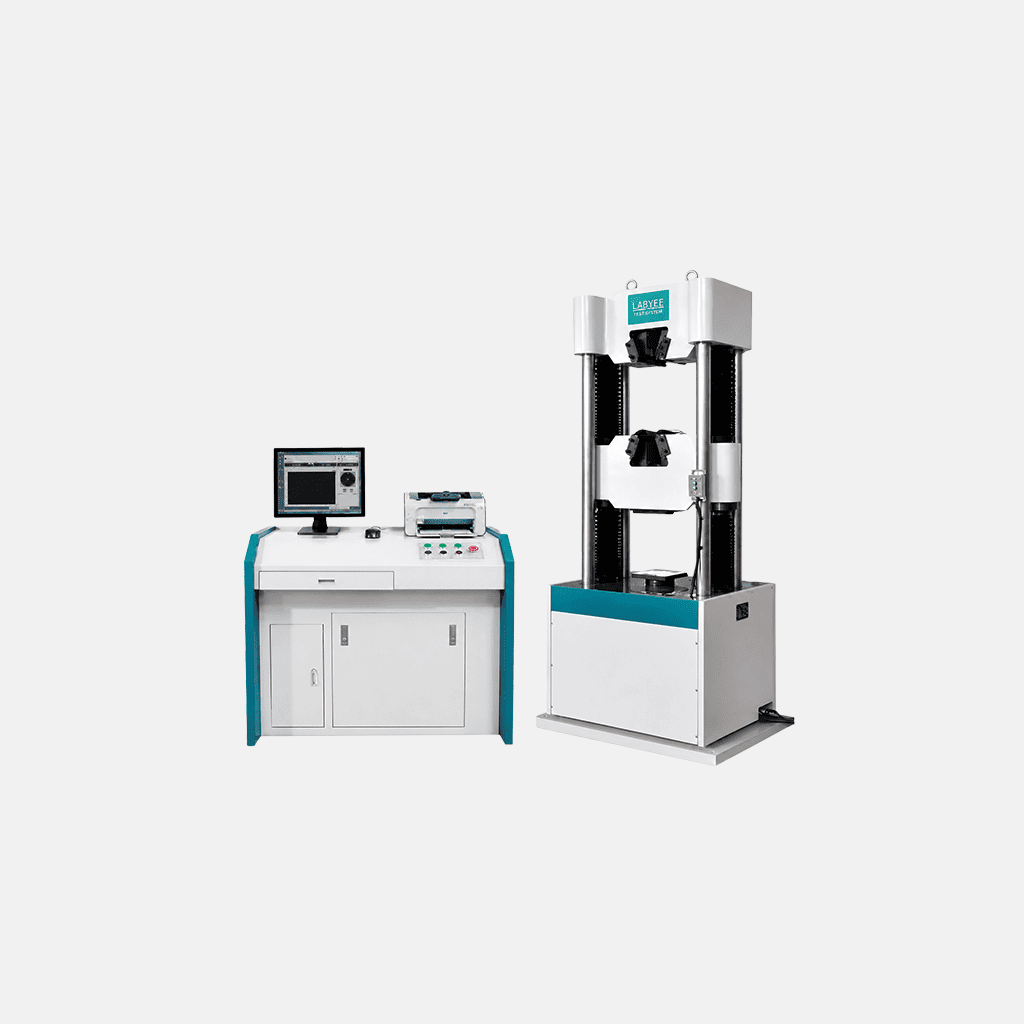
Universal Testing Machine (UTM)
Warranty
Installation
Training
Product overview
Labs juggling multiple test types shouldn’t need multiple machines, and this universal testing machine (UTM) solves exactly that.
This line of universal testing machines was built to handle a lot without asking a lab to switch equipment every time the test type changes. Tension, compression, bending, shearing, all four run on metal materials, and the same machines handle compression and bending work on nonmetal materials like cement and concrete just as well. Add a few simple accessories, and the machine can move into mechanical property testing for fasteners, wire rope, and other components too, which is really what makes it a universal testing machine in practice, not just in name.
That kind of flexibility explains why these machines end up in so many different settings, project quality testing departments, university and college labs, research institutions, industrial operations, mining enterprises. As a trusted universal testing machine supplier, across UAE, Saudi Arabia, Qatar, Kuwait, Oman, and Bahrain, BDHME helps labs select the right configuration for their specific tensile test universal testing machine needs. Calibration is done in line with ASTM E4 and ISO 7500-1, part of the broader universal testing machine calibration process that keeps results trustworthy over time. When it comes to actually running tests, the machine’s tensile test universal testing machine capability, along with bending and other test modes, covers ISO 6892, ISO 7438, ASTM A370, ASTM E8, and BS EN standards. For labs juggling multiple regulatory requirements at once, having that range of standards already built in saves a fair amount of hassle down the line.
Hydraulic clamping system
Tension testing runs through a hydraulic clamp with a wedge design that auto-locks as load builds. Round and flat grips swap out depending on the sample, so switching between specimen types doesn’t mean stopping to reconfigure the whole setup.
Host machine structure
The host is built around a bottom-mounted oil cylinder, with hydraulic load application and hydraulic clamping working together. Tensile jaws stay fixed on the cross beam, which honestly makes installing and releasing samples a lot less fiddly than older manual designs tend to be.
Servo motor driven oil pump
This is where the fast response comes from, along with lower noise and lower operating temperature. It also just holds up reliably over long stretches of use, which matters more than it sounds once a lab is running tests daily.
Micron-level clearance sealing
Rather than depending on O-ring seals, the system uses micron-level clearance sealing instead. Loading stays stable as a result, and there’s a lot less maintenance to deal with over the machine’s working life.
Three closed-loop control modes
Testing runs through computer control across load, displacement, and extension, giving operators room to choose whichever mode actually fits the test at hand.
External controller
The controller sits outside the main unit and connects to a computer over USB, keeping the whole setup fairly uncomplicated on the hardware side.
Flexible unit conversion
Switching between N, kN, lbf, gf, and kgf takes no extra effort, which helps when working with clients or standards from different regions.
Adjustable speed control
Speed adjusts anywhere from 0.1 to 50mm/min through the servo motor, giving operators fine control depending on what the material or test calls for.
Sensor and extensometer capacity
Up to 3 force sensors and 8 extensometers can run at once, which comes in handy for more involved testing setups that need several measurements captured simultaneously, and it factors directly into the machine’s overall universal testing machine capacity.
Full computer control
Everything from the test process itself to result display, analysis, and printing runs through the computer, with data and curves showing up in real time as the test progresses. This is really where the universal testing machine software earns its keep, cutting out a lot of the manual tracking that older testing setups required.
Multiple curve types
Load-Time, Extension-Time, Stress-Strain, Load-Extension, and other curve formats are all available, so engineers can look at the same test results from whichever angle tells them what they need to know.
Zoom and point analysis
Any point along a curve can be zoomed into and examined individually, useful when something specific in the data needs a closer look.
Automatic property calculation
Tensile strength, yield strength, modulus of elasticity, Rp0.2, and Rt0.5 all get calculated automatically, which saves time and takes some of the risk of manual calculation error out of the picture.
Excel-compatible reporting
Reports export directly into Excel format, making it easier to track down and reference specific data points later on.
Continuous group testing
Multiple samples from the same group can run through testing back to back, with each result still broken out and analyzed on its own afterward.
Data and curve storage
Test results, curves, and raw data all get stored, so nothing needs to be re-run just to pull up a past comparison.
Automatic stop on specimen failure
A stop-while-destroy function kicks in automatically once a specimen breaks, protecting both the machine and whoever’s operating it.
Remote crosshead control
A remote controller lets the crosshead be adjusted before testing starts, without needing to stand right at the machine to do it.
Windows compatibility
The system runs on several versions of Microsoft Windows, including Windows 7, 8, and 10.
Network connectivity
The machine can be linked into an enterprise or laboratory information network, which matters for labs pulling data together across multiple testing stations or departments.
At its core, the universal testing machine working principle is fairly simple to describe, even if the engineering behind it isn’t: a controlled force gets applied to a specimen, and the machine measures how that specimen responds, whether it’s being stretched, compressed, bent, or sheared. Referencing a basic universal testing machine diagram helps visualize this: the universal testing machine components, hydraulic clamps, load cells, the cross beam, extensometers, and the control system, all work in coordination to apply that force precisely and capture the resulting data as it happens. Once you understand that basic principle, it becomes a lot clearer why specific universal testing machine parts in this series, the servo-driven oil pump, the micron-level sealing, matter as much as they do for both accuracy and how long the machine holds up under regular use.
For labs weighing different universal testing systems and thinking through universal testing machine capacity against their actual testing load, this series brings a pretty complete range into one machine, tension, compression, bending, and shear, without needing separate equipment sitting around for each individual test type.
Find the Right Solution for Your Laboratory
Need help selecting the right product for your application? Our specialists can guide you with product specifications, pricing, installation, and technical support across the UAE and Middle East.